






Most people wait too long. The car sits on the driveway for months — sometimes years — because the owner assumes it’s not worth the bother. No MOT, won’t start, or just too old and tired to sell privately. It feels like dead weight.
But here’s the thing: you can sell your car in any condition, and in most cases it’s worth more than you think. The mistake most people make is assuming a car that can’t be driven has no value. That’s rarely true.
This guide is for anyone who’s been putting off dealing with a problem vehicle — whether that’s because you don’t know what it’s worth, you’re not sure how to move it, or you’ve had a bad experience with a buyer before.
Why Condition Matters Less Than You Think
The private car market is unforgiving of imperfection. Try to sell a car with high mileage, visible rust, or a patchy service history on a classified site and you’ll either get lowball offers or no interest at all. That’s because private buyers want a car they can drive away and rely on.
The scrap and salvage market works completely differently. Buyers in this space aren’t looking for a car to use — they’re looking for metal, parts, or a project. A seized engine isn’t a dealbreaker to someone who wants the gearbox. A rusted shell still has weight in steel. A car that failed its MOT on emissions might have a perfectly good body and interior.
When you sell your car in any condition through the right channel, the question shifts from “is this car good enough?” to “what is this car made of, and what’s the best use for it?” That’s a much more forgiving calculation for the seller.
Is My Car Worth Scrapping — Or Is There a Better Option?
This is the question most people don’t think to ask. Scrapping and selling for salvage are not the same thing, and the difference can mean a meaningfully higher return — subject to valuation.
Scrapping means the vehicle goes to an Authorised Treatment Facility (ATF), where it’s drained of fluids, depolluted, and crushed. The price you receive is based primarily on the car’s kerb weight and the current price of scrap metal. It’s straightforward and consistent, but it’s typically the floor price for a vehicle — not the ceiling.
Salvage means the car has value beyond its weight. This applies when the vehicle has usable parts — a good engine, low-mileage running gear, a clean interior, sought-after alloys. Salvage buyers will pay more than scrap price because they can recover that value by breaking the car or repairing it for resale.
If you’re asking “is my car worth scrapping?” the honest answer is: it depends on whether it has salvage value first. Get a quote from a buyer who handles both — they’ll tell you which category your car falls into.
Have you ever been surprised by what a car turned out to be worth — or disappointed? Share in the comments. It helps other readers set realistic expectations.
How Much Is a Non-Runner Actually Worth?
This is the anxiety at the heart of most delayed decisions. People assume a car that doesn’t run is worth next to nothing — and occasionally that’s true, but it’s far less common than people expect.
What determines a non-runner’s value:
Make and model — a non-running BMW or Land Rover has more parts value than a non-running city car, simply because the parts are worth more on the used market.
Why it doesn’t run — a flat battery or a snapped cambelt is not the same as a seized engine block. The nature of the fault matters enormously. Some non-runners are one straightforward repair away from being roadworthy, which makes them attractive to trade buyers.
Age and body condition — a ten-year-old car with a good body and interior but a dead engine is worth more than a running car that’s been poorly maintained and is visibly corroded.
Current scrap metal prices — these fluctuate with global commodity markets. A heavier car in a period of strong steel prices will return a better scrap floor price.
The honest answer is that you won’t know the number until you get a quote. But “nothing” is almost never the right answer for a non-runner in reasonable overall condition.
Sell Unwanted Car for Cash — The Options Compared
If you want to sell an unwanted car for cash, you broadly have four routes. Here’s how they compare honestly:
Private sale — highest potential return, but only works if the car is presentable, driveable, and has a valid MOT or is clearly worth repairing. A non-runner or MOT failure will struggle here and may attract time-wasters.
Part exchange — dealerships will take almost anything in part exchange, but the offer will reflect their need to dispose of it quickly. Expect a low valuation on anything below standard.
Online car buying platforms — convenient, but typically focused on roadworthy vehicles. Many will revise their offer significantly on inspection if the car has undisclosed condition issues. Read the terms carefully.
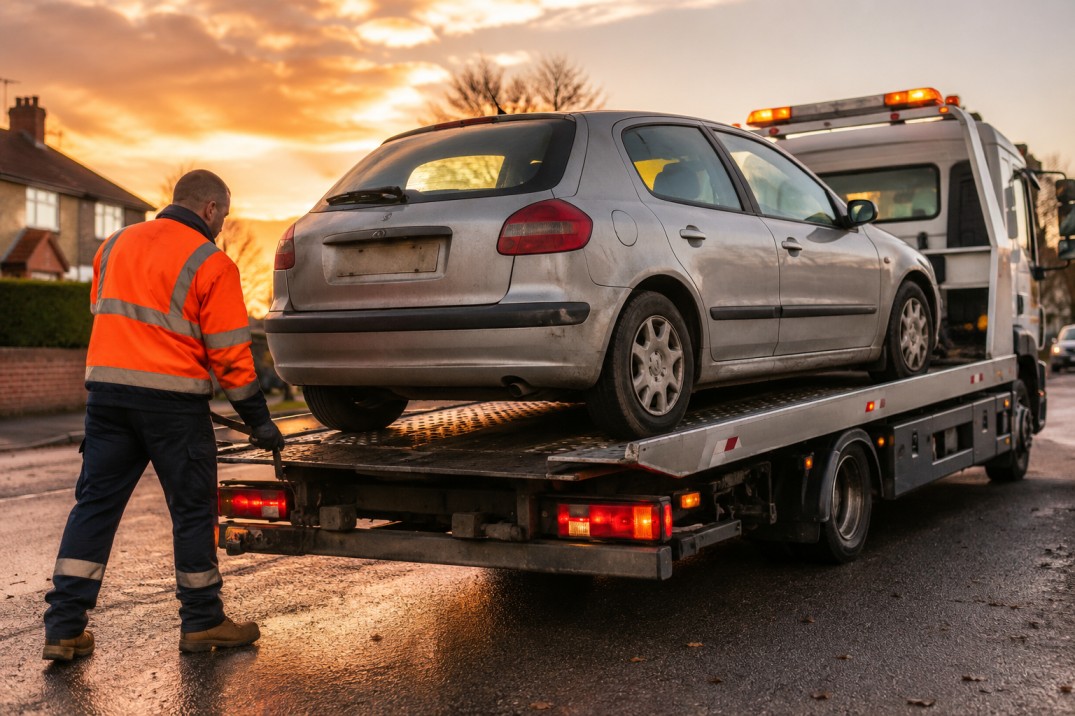
Specialist scrap and salvage buyers — the right choice for non-runners, MOT failures, and damaged vehicles. These buyers have the infrastructure to collect, the expertise to value accurately, and no interest in condition as a barrier. Payment is typically by bank transfer on the day of collection.
For most people reading this, the fourth option is the most practical and often the most financially sensible — precisely because it’s designed for the situation you’re actually in.
Scrap Car Value in Yorkshire: What Drives the Price
If you’re based in Yorkshire — Sheffield, Leeds, Halifax, or the surrounding areas — scrap car value is influenced by the same factors as anywhere in the UK, but local collection costs and buyer competition also play a role.
Imagine you’ve got a 2008 Ford Focus sitting outside your house in Sheffield. It failed its MOT six months ago on a combination of brake wear and structural corrosion. You’ve had one quote from a local yard that felt low, and you’re not sure whether to accept it.
The right move here is to get at least two or three quotes. Scrap and salvage prices are not fixed — different buyers have different outlet channels, different part requirements, and different margins. A buyer who happens to need a 2008 Focus for parts will offer more than one who’s simply going to crush it.
What you shouldn’t do is let the car sit another six months. Corrosion progresses. Tyres flat-spot. Animals nest. A car that’s worth something today is worth less in a year of neglect.
If you want a clear breakdown of what affects scrap car value and how to push for a better offer,this guide covers the key pricing factors in plain terms.
How to Sell Your Car in Any Condition Without Getting Burned
The scrap and salvage market is mostly legitimate, but there are a handful of practices worth knowing about before you commit to a buyer.
Watch for offer revision on collection. A reputable buyer will inspect the car before agreeing a final price. What you want to avoid is a buyer who quotes high over the phone and then significantly reduces the offer at the door, knowing you’re under pressure to say yes. If a quote seems unusually high compared to others, treat it with caution.
Never pay for collection. Genuine buyers who deal in scrap, salvage, and non-runners offer free collection as standard. If someone asks you to cover recovery costs, walk away.
Check they’re using an ATF. If your car is going to be scrapped, the buyer must process it through an Authorised Treatment Facility. Ask for this confirmation upfront and request a Certificate of Destruction once the vehicle has been processed. This is your proof that the car has been legally disposed of — without it, the DVLA record may still show the vehicle in your name.
Sort your V5C (logbook) before collection day. You’ll need it to complete the transfer properly. If you’ve lost it, apply for a replacement from the DVLA or flag it with your buyer early — most will work around it, but it’s cleaner with the paperwork in order.
First time selling a scrap or non-runner? Drop a question in the comments — it’s a process that sounds more complicated than it is, and a quick answer might save you time.
TL;DR / Key Takeaways
- A car that doesn’t run, has failed its MOT, or is damaged can still be sold — often for more than you’d expect
- Scrapping and salvage are different things; salvage value is usually higher if your car has usable parts
- Non-runner value depends on make, model, fault type, body condition, and current scrap metal prices
- Get multiple quotes — prices vary between buyers depending on their outlet channels
- Never pay for collection; always confirm the buyer uses an Authorised Treatment Facility (ATF)
- Request a Certificate of Destruction once your car is processed to clear your DVLA record
If you’re in Yorkshire or the Midlands and want a straightforward quote on a car you’d rather not keep, UK Motor Buyers handle non-runners, MOT failures, and damaged vehicles — free collection included, payment by bank transfer on the day.

I am here to contribute Blogs regarding latest trend.