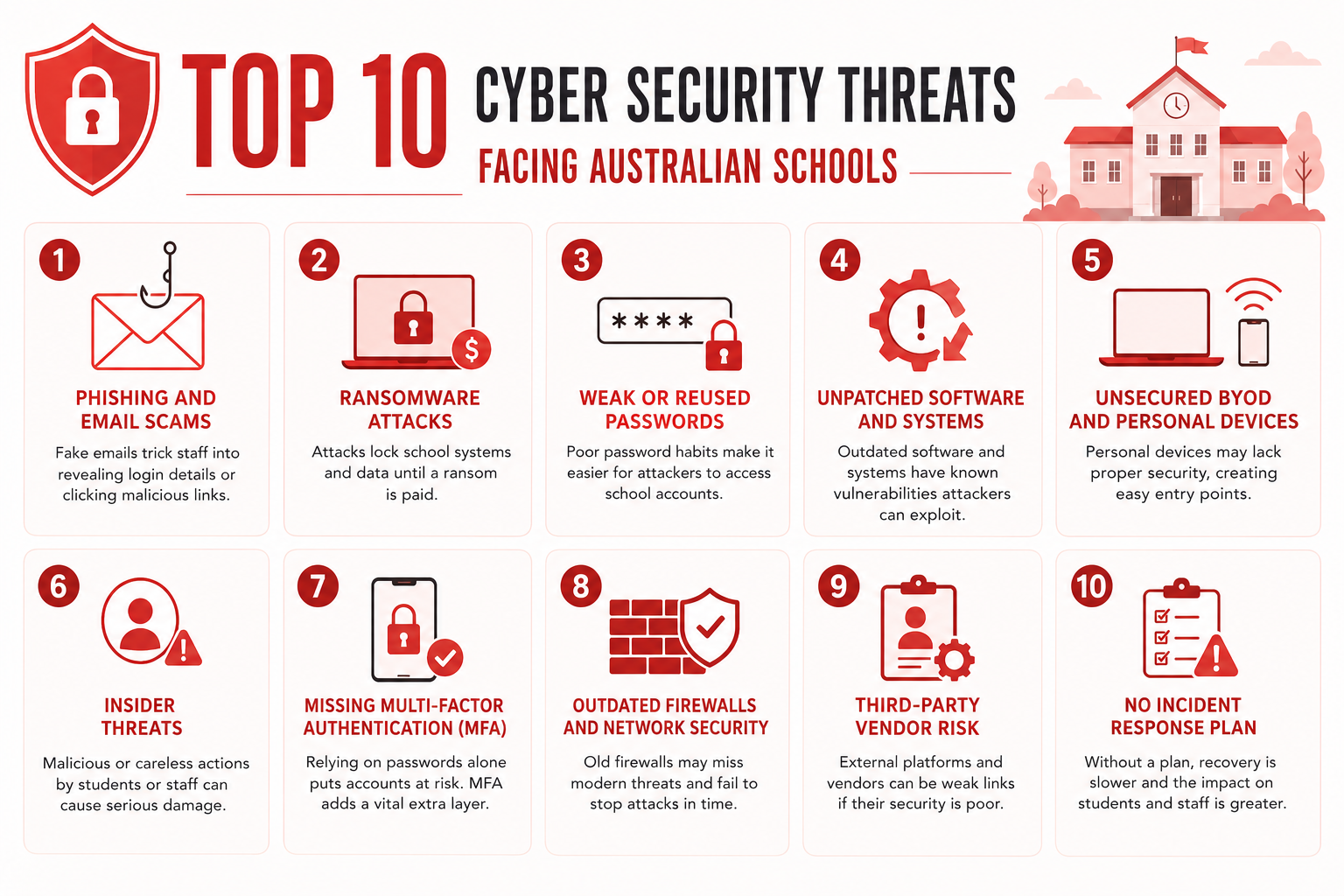
Schools hold some of the most sensitive data around: student records, medical details, family information, and financial data. That makes them an attractive target for cybercriminals, even though most schools lean IT teams and tight budgets. Here are the top 10 cybersecurity threats every Australian school should know about, plus what you can do about each one.
1. Phishing and Email Scams
Phishing is still the easiest way into a school’s network. A staff member clicks a fake invoice or an “urgent” email from “the principal,” and login details are handed straight to an attacker. Schools are especially vulnerable because email volume is high and staff are often juggling multiple roles. Regular staff training and email filtering tools go a long way toward reducing this risk.
2. Ransomware Attacks
Ransomware locks up school systems, including student records, timetables and finance software, until a ransom is paid. Education is one of the most targeted sectors in Australia because schools often lack the backup and recovery systems needed to bounce back quickly. Regular, tested backups and network segmentation are the best defence here.
3. Weak or Reused Passwords
Staff and students often reuse the same password across multiple platforms, including personal accounts. If one of those accounts is breached elsewhere, attackers can use the same credentials to get into school systems. A clear password policy, combined with a password manager, removes most of this risk.
4. Unpatched Software and Systems
Old software versions are full of known security gaps that attackers actively scan for. Schools running outdated learning management systems, servers, or even smart boards are leaving the door open. A regular patch management schedule closes these gaps before they’re exploited.
5. Unsecured BYOD and Personal Devices
Bring-your-own-device policies are common in schools, but personal laptops and phones rarely have the same security standards as school-issued equipment. An unsecured device connecting to the school Wi-Fi can become an easy entry point. Network segmentation, keeping student and staff devices on separate VLANs, helps contain the damage if a device is compromised.
6. Insider Threats
Not every threat comes from outside. Curious students testing the limits of the school network, or a disgruntled staff member with admin access, can cause just as much damage as an external hacker. Role-based access control, so people only see what they need to do their job, limits the blast radius.
7. Missing Multi-Factor Authentication (MFA)
A password alone is no longer enough. MFA adds a second check, like a code sent to a phone, before access is granted. Several Australian schools have only adopted MFA after insurers made it a condition of cover. Rolling it out across staff and admin accounts is one of the cheapest, highest-impact fixes available.
8. Outdated Firewalls and Network Security
An ageing firewall might still technically “work,” but it won’t catch modern threats. Many schools are still running hardware that’s five, even ten, years old. A firewall upgrade paired with proper network monitoring catches suspicious activity before it turns into an incident.
9. Third-Party Vendor Risk
Schools rely on dozens of external platforms: learning tools, payment portals, canteen apps, excursion booking systems. Each one is a potential weak link if the vendor itself gets breached. Vetting vendors for their own security practices and limiting what data is shared with each one reduces this exposure.
10. No Incident Response Plan
When an attack does happen, the schools that recover fastest are the ones with a plan already in place: who to call, what to shut down, how to communicate with parents and staff. Without one, even a small incident can spiral into days of downtime and reputational damage. A documented, tested response plan should sit alongside any cybersecurity strategy.
Staying Ahead of Cyber Threats
Cyber security for schools isn’t a one-off project; it’s an ongoing process of monitoring, training, and updating systems as new threats emerge. NetStrategy works with more than 400 Australian independent schools to build exactly this kind of resilience, from firewall upgrades and MFA rollouts to full NIST CSF and Essential 8 assessments. Book a free 90-minute consultation to identify your school’s biggest gaps, or take the free Cybersecurity Self-Assessment for a quick read on where things stand today.
Frequently asked questions
What is the biggest cybersecurity risk for schools?
Phishing remains the most common entry point, since it relies on human error rather than a technical flaw, making it hard to block with software alone.
How often should a school review its cybersecurity?
At least once a year, with ongoing monitoring in between. Insurance renewals and major software changes are also good trigger points for a fresh review.
Do small or rural schools need cybersecurity, too?
Yes. Attackers often target smaller schools precisely because they assume security is weaker there, not because the data is less valuable.

I am here to contribute Blogs regarding latest trend.