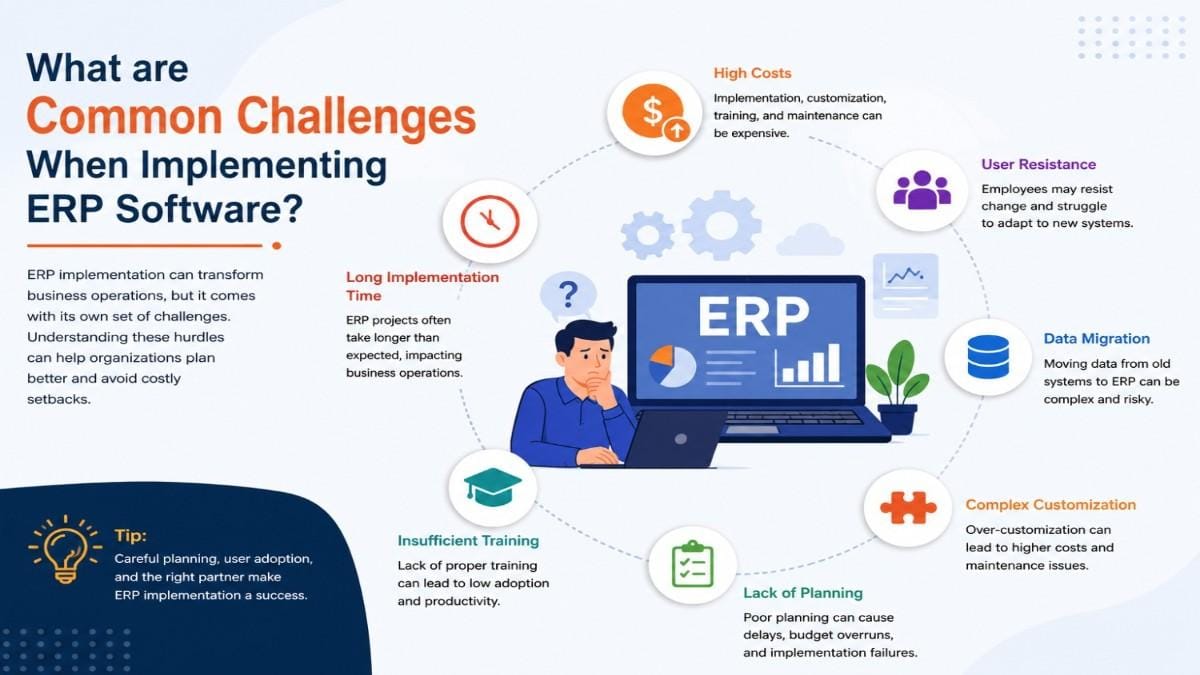
Rarely does rolling out a new system go to plan. ERP implementation challenges are present in almost every project and knowing them up front makes the difference between a smooth rollout and a costly delay.
ERP implementation projects are complex because they impact all facets of a business at once. Finance, operations, sales and inventory all migrate to a new system together.
“Preparation and planning mean more than most teams think when they go in. When there is a rushed timeline or a vague plan, problems almost always crop up once the project actually gets going.
Implementation challenges directly impact business results. A delayed rollout costs money in lost productivity, a poorly executed one can hamper operations for months afterwards.
This article takes a look at the most common ERP implementation challenges and discusses practical ways a business can work through each one.
A team that understands the challenges of ERP implementation prior to the start of the project can plan to avoid them rather than simply react to the problems that arise during the project.
Why ERP Implementations Face Challenges
A big one is organizational complexity. Bigger companies have more departments, more workflows, more people who have to adapt to the new system.
Collaboration across functions is crucial in the implementation phase, as finance, operations, and IT teams all rely on the same system working correctly together.
Another level of difficulty is business processes change. And an ERP rollout is often not just a change in software but a change in the way departments work.
Taken together, these three factors make ERP implementation challenges appear more significant than a typical software roll-out, even when the software itself is working perfectly.
Knowing this from the start lets a project team set realistic expectations instead of assuming the rollout will be as fast as installing a simple application.
Most Common ERP Implementation Challenges
Unclear Project Goals
A project without a clear goal struggles to measure success. Teams are left guessing as to what the new system should actually do for the business.
This confusion often results in a system that is implemented but never quite solves the problems it was intended to solve.
A specific goal such as improving inventory accuracy or reducing order processing time provides the entire project team with something concrete to work towards.
Poor Requirements Gathering
The system is configured around assumptions, by bypassing detailed requirements gathering, instead of actual business needs.
Departments are never asked what they need and often find holes only after the system is in place – by which time fixing those holes costs much more time and money.
Data Migration Issues
One of the most common challenges a business faces as it implements ERP is the migration of data from legacy systems to a new ERP platform.
When a company migrates data without first cleaning it up, problems arise from duplicate records, out-of-date information and inconsistent formatting.
This is often an underestimated step by businesses, who spend weeks after go live fixing data errors that could have been caught before the migration even started.
Integration with Existing Systems
Most companies already use other software, like accounting applications, e commerce platforms or scheduling systems. The new ERP must integrate seamlessly with these tools.
A lack of integration means employees have to maintain manual workarounds, which negates a lot of the point of implementing ERP software.
Employee Resistance to Change
Employees comfortable with old processes often resist a new system, especially if they were not involved in planning the change.
This resistance slows adoption and can undermine the entire project, even when the new system genuinely improves how work gets done.
Employees who feel left out of the decision often see the new system as something imposed on them, rather than a tool built to make their job easier.
Inadequate User Training
A system that employees do not understand will not deliver its intended value, regardless of how powerful its features are.
Rushed or incomplete training leaves staff falling back on old habits, workarounds, or manual spreadsheets instead of using the new system correctly.
Budget Overruns
ERP projects can easily go over budget, especially if data migration, customization or training requirements are underestimated at the beginning.
Budget overruns can strain the relationship between a business and its implementation partner and lead a company to cut corners late in the project.
At this point, cutting corners usually means skipping testing or training and that just creates more ERP implementation challenges once the system actually goes live.
Project Scope Creep
Scope creep occurs when new requirements are added after the project plan has been established.
Every new addition pushes out the timeline and adds cost . No one is tracking the cumulative impact until the project is way behind schedule .
Weak Executive Sponsorship
If there is no visible leadership support, ERP projects can lose priority to other business issues.
Weak sponsorship also makes it difficult to secure the budget, staff time and cross department cooperation an implementation actually requires.
When leadership clearly backs the project, it tells the entire company that this is important – and that can help to overcome resistance in departments that might otherwise push back.
Post Implementation Support Gaps
Many ERP implementation challenges do not show up until after the system is live, when daily use reveals issues that testing missed.
If a company lacks a clear support plan for this transition, the employees who are still getting used to the new system can become frustrated quickly.
Planning for this stage ahead of time, instead of seeing go live as the finish line, avoids many of these late stage frustrations becoming larger issues.
How to Overcome ERP Implementation Challenges
Create a Detailed Implementation Plan
A detailed plan lays out every phase of the rollout, including timelines, responsibilities, and specific milestones the team needs to hit.
This plan enables the project team to catch delays early, rather than discovering a missed deadline after it has already affected other parts of the project.
Build a Cross Functional Project Team
A cross functional team brings representatives from finance, operations, IT, and other departments into the planning process from the start.
This approach enables the system to reflect real workflow needs across the business, not just the assumptions of a single department.
Departments that feel heard during planning also tend to adopt the new system faster, since they see it as something built with their input, not without it.
Clean and Validate Data Before Migration
Cleaning data before migration removes duplicates, corrects errors, and standardizes formatting so the new system starts with accurate information.
Validating this data afterward confirms nothing important got lost or corrupted during the transfer from the old system.
Invest in Training and Change Management
Strong training programs help employees feel confident that they are using the new system correctly from the get-go, instead of guessing.
- Provide hands on training before go live
- Offer refresher sessions during the first few weeks
- Assign power users who can support their teams directly
Change management is the people side of implementation. It helps employees understand why the change is happening, and how it helps them in their day to day.
Test Before Going Live
Thorough testing catches errors before they get to the live system where mistakes impact real transactions and real customers.
Each module and workflow must be tested in real business scenarios, not just with sample data that does not reflect actual daily use.
One of the easiest ways to sidestep many of the ERP implementation challenges discussed earlier in this article is to test extensively before go live.
Monitor KPIs After Deployment
Measuring KPIs after the system has gone live will tell you whether your new system is really delivering the benefits your project set out to achieve.
- Order processing time compared to the old system
- Data accuracy across departments
- Employee adoption and daily active use
- Cost savings against the original project budget
A business that keeps track of these numbers regularly can spot problems before it is too late to do anything about them.
Best Practices for Long Term ERP Success
Continuous improvement ensures the system remains aligned with the business as needs change over time, rather than treating implementation as a one time event.
After go live, regular user feedback helps identify pain points that might not have been caught in testing.
Regular software updates ensure the system is secure, up to date and in line with new business requirements as the company evolves.
Performance monitoring, well after the initial launch, shows that the ERP system still provides value long after the excitement of go live is over.
Companies that stay this vigilant seldom fall back into the same problems that caused issues during the initial implementation phase.
Conclusion
The key to turning implementation challenges into long term business success is honest planning, great training and consistent follow through once the system goes live.
Every time a business launches a new platform, it will encounter some ERP implementation challenges along the way. The success or failure of a rollout depends on how prepared the team is to deal with them.
It’s not luck, most companies prepare for a smooth ERP rollout and see it through to the end.
Intersoft ERP is a team that has experience in leading companies through these challenges and is focused on supporting clients from planning through long term success, a partner that businesses seeking a partner should consider.